
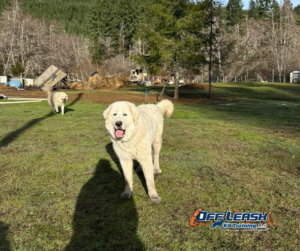
You’re enjoying a walk with your dog when another dog appears down the sidewalk. Suddenly, your dog starts barking, pulling, or lunging toward them.
You try calling their name, asking them to sit, or shortening the leash. But your dog seems completely focused on the other dog.
If you’ve been wondering, “How do I get my dog to stop barking at other dogs?” the first step is understanding why the behavior happens.
Dogs bark at other dogs for different reasons, including fear, excitement, frustration, and discomfort. Some dogs want to approach, while others want more space.
The good news is that appropriate training and management can help many dogs develop calmer responses.
The goal isn’t necessarily to make your dog enjoy interacting with every other dog. It’s to help them feel more comfortable and remain manageable when other dogs are nearby.
In this guide, we’ll explain the common causes of barking, how to recognize leash reactivity, and practical steps to make walks more manageable.
Why Does My Dog Bark at Other Dogs?
Dogs may bark at other dogs because they feel afraid, frustrated, excited, or uncertain about the interaction.
Barking is a natural form of communication. However, repeated barking, pulling, or lunging during encounters can become difficult to manage.
This behavior is often described as dog reactivity.
A reactive dog responds strongly to particular situations or triggers. These responses may include barking, lunging, freezing, intense staring, or attempting to retreat.
Reactivity doesn’t automatically mean aggression.
For example, a dog who barks because they want to play may appear similar to a dog who barks because they want another dog to move away.
Although body language provides useful clues, it isn’t always possible to determine a dog’s motivation from a single encounter.
Understanding the circumstances surrounding the behavior can help you choose a safer and more appropriate approach.
5 Common Reasons Dogs Bark at Other Dogs
1. Fear or Uncertainty
Some dogs feel uncomfortable when unfamiliar dogs approach.
Barking may be an attempt to create distance from something they find threatening.
You might notice other signs, such as:
- A stiff or lowered body posture
- Ears pulled back
- Turning away or attempting to retreat
- Freezing before barking
- Growling or other defensive behavior
Not every dog shows these signals in the same way.
If your dog appears frightened, avoid forcing them into close greetings to make them “get used to” other dogs.
Providing space is usually a safer starting point.
2. Leash Frustration
Some dogs enjoy interacting with other dogs but become frustrated when restrained by a leash.
They can see another dog but cannot approach freely.
This frustration may lead to:
- Barking
- Whining
- Pulling toward the other dog
- Jumping
- Lunging
Some dogs display these behaviors mainly during leash walks.
However, barking on leash doesn’t automatically mean your dog wants to greet another dog. Fear and frustration can produce similar-looking reactions.
3. Excitement and High Arousal
Not all barking is motivated by fear.
Some dogs become extremely excited when they see another dog.
Their excitement may increase until they struggle to respond to familiar commands.
For these dogs, practicing calm observation, attention cues, and manageable interactions may help.
The goal is to teach your dog that seeing another dog doesn’t always mean an immediate greeting or play session.
4. Previous Negative Experiences
A dog who has been frightened, chased, or attacked by another dog may become cautious around unfamiliar dogs.
They may begin barking when another dog approaches because they anticipate an uncomfortable interaction.
However, a previous negative experience isn’t always necessary for reactivity to develop.
Dogs can become reactive for several reasons, including individual temperament, environmental factors, and learning history.
Dogs with significant fear often need gradual, carefully managed exposure rather than unpredictable encounters.
5. Limited Experience Around Other Dogs
Some dogs haven’t had enough appropriate opportunities to become comfortable around unfamiliar dogs.
However, socialization doesn’t mean meeting as many dogs as possible.
A dog can benefit from calmly observing other dogs at a comfortable distance without interacting directly.
The goal is to develop confidence and appropriate responses, not force repeated greetings.
For dogs who are already fearful or reactive, structured behavior modification may be more appropriate than ordinary socialization activities.
Is My Dog Reactive or Aggressive?
Reactivity and aggression can overlap, but they aren’t interchangeable.
A reactive dog may bark or lunge because they’re excited, frustrated, frightened, or uncomfortable.
Aggressive behavior may include threats or actions that could injure another animal. These behaviors can occur for different reasons, including fear and attempts to increase distance.
A dog can be reactive without intending to make contact. However, some reactive displays can escalate into dangerous encounters.
Don’t assume that barking alone proves aggression or that an excited-looking dog is safe to approach.
Consider the full situation, including:
- The distance between the dogs
- Your dog’s posture and movement
- Whether your dog attempts to approach or retreat
- How quickly the reaction begins
- Whether your dog can disengage
- Any history of snapping or biting
The VCA Animal Hospitals guide to aggression toward unfamiliar dogs explains why understanding a dog’s history and motivation is important when evaluating aggressive behavior.
If your dog has attempted to bite another dog, repeatedly threatens dogs at close range, or cannot be safely controlled, seek qualified professional guidance.
How to Get Your Dog to Stop Barking at Other Dogs: 6 Steps
Reducing barking around other dogs involves managing difficult situations and helping your dog develop more comfortable responses.
Start in quiet environments and increase the difficulty gradually.
Step 1: Identify Your Dog’s Triggers
Begin by observing when barking occurs.
Ask yourself:
- Does your dog bark at every dog or only certain dogs?
- Does the barking happen mainly on leash?
- Is the reaction stronger when another dog approaches directly?
- Can your dog observe another dog calmly from farther away?
- Does your dog appear frightened, frustrated, or excited?
- Does your dog react differently in familiar and unfamiliar places?
Keep a simple record of barking episodes.
Include the location, approximate distance, behavior, and what happened immediately before the reaction.
For example, you may notice that your dog can comfortably watch another dog across the street but becomes tense when passing on a narrow sidewalk.
These patterns can help you choose more manageable training situations.
Step 2: Find Your Dog’s Comfortable Distance
Distance is one of the most useful tools when working with reactive dogs.
Begin far enough away that your dog can notice another dog without becoming overwhelmed.
At a comfortable distance, your dog may still be able to:
- Respond to their name
- Look toward you voluntarily
- Accept a favorite treat
- Move with a relaxed body
- Disengage from the other dog
If your dog becomes stiff, stares intensely, barks, or lunges, the situation may be too difficult.
Move farther away when it’s safe.
There isn’t one correct distance for every dog.
Your dog’s comfort level can change depending on the environment, the other dog’s behavior, and what happened earlier in the day.
Don’t force your dog to remain close to another dog while they’re distressed.
Step 3: Reward Calm Observation
When your dog notices another dog at a comfortable distance, create a positive experience before barking begins.
For example:
- Your dog notices another dog across a park.
- They remain comfortable enough to observe without reacting.
- You mark the moment with “Yes” or another consistent marker.
- You provide a favorite treat.
- You allow another brief, manageable observation or calmly move on.
Repeat during short practice sessions.
The purpose is to help your dog develop more positive associations with seeing other dogs while reinforcing calm behavior.
If your dog becomes frightened, increase the distance instead of asking them to remain close to the trigger.
Avoid using treats to lure a fearful dog into an interaction they’re not ready to handle.
Step 4: Teach Your Dog to Check In With You
An attention cue can help your dog redirect their focus before a reaction begins.
Start in a quiet room at home.
Say your dog’s name once.
When they look toward you, mark and reward the response.
Repeat until your dog consistently turns toward you.
Then practice in another familiar setting, such as your backyard.
Eventually, try the cue when another dog is visible at a comfortable distance.
Keep expectations realistic.
If your dog is already barking intensely, creating distance may be more useful than repeatedly asking them to look at you.
Step 5: Practice a Calm U-Turn
A U-turn gives you a practical way to move away when another dog approaches unexpectedly.
Practice without distractions:
- Walk forward with your dog on a leash.
- Say a consistent cue, such as “This way.”
- Turn and encourage your dog to follow.
- Reward them for moving with you.
- Continue walking in the new direction.
Practice several times in a quiet setting.
As your dog becomes familiar with the exercise, introduce mild distractions.
The goal is to make changing direction a predictable, manageable activity.
A practiced U-turn can be especially useful on neighborhood sidewalks where you don’t always have enough room to pass another dog comfortably.
Step 6: Gradually Practice Around Other Dogs
Once your dog can observe other dogs comfortably from a distance, carefully adjust the difficulty.
For example, you might practice:
- While another dog walks at a comfortable distance
- In a slightly different outdoor setting
- With mild background distractions
- At a somewhat closer distance, if your dog remains relaxed
Change only one factor at a time.
If your dog begins barking, lunging, freezing, or showing other signs of distress, return to an easier situation.
The VCA guide to desensitization and counterconditioning explains how gradual exposure and positive associations can help address emotional responses.
The goal isn’t to repeatedly expose your dog to situations they cannot handle.
It’s to create manageable learning experiences.
Dogs with significant fear, aggression, or bite histories need an individualized plan developed with a qualified professional.
What to Do if Your Dog Starts Barking During a Walk
Even with consistent training, unexpected encounters happen.
Imagine walking through a Portland neighborhood when another dog suddenly appears around a corner.
Your dog begins barking and pulling toward the other animal.
Here’s how to respond.
Stay calm. Avoid yelling or repeatedly giving commands your dog cannot currently follow.
Create distance. Cross the street, turn around, or move behind a visual barrier when it’s safe.
Keep the leash secure. Use properly fitted equipment that allows you to maintain control without causing unnecessary discomfort.
Avoid forced greetings. Don’t allow another dog to approach closely just because someone says their dog is friendly.
Give your dog time to recover. Once you’re away from the trigger, allow your dog to settle before deciding whether to continue the walk.
If your dog has a bite history or is difficult to control safely, follow an individualized safety plan developed with a qualified professional.
Common Mistakes That Can Make Dog Reactivity Worse
Forcing Your Dog to Meet Other Dogs
Repeated close encounters can be overwhelming for dogs who are frightened or uncomfortable.
Your dog doesn’t need to greet every dog they see.
Calmly passing another dog is a valuable skill on its own.
Punishing Barking or Growling
Barking and growling can communicate discomfort.
Punishing warning signals may increase fear without addressing the underlying problem.
The American Veterinary Society of Animal Behavior’s position statements recommend reward-based methods for dog training and behavior modification.
Focus on identifying why your dog is reacting and creating safer, more manageable situations.
Moving Too Close Too Quickly
A dog who succeeds from across the street may not be ready to pass another dog on a narrow sidewalk.
Increase difficulty gradually.
If your dog struggles, return to a distance where they can remain comfortable.
Allowing Repeated Uncontrolled Encounters
If your dog repeatedly experiences stressful encounters during every walk, progress may become more difficult.
Consider quieter routes and walking times while practicing new skills.
Assuming Every Bark Means Aggression
Some dogs bark because they’re excited or frustrated.
Others are frightened or trying to create distance.
Avoid labeling the behavior based on barking alone.
Look at the circumstances and seek professional assessment when safety is a concern.
Can You Socialize a Reactive Dog?
Yes, but the process may look different from traditional puppy socialization.
For many reactive dogs, successful experiences involve calmly observing other dogs rather than interacting with them.
For example, your dog may practice remaining comfortable while another leashed dog walks at a distance.
This can be more manageable than entering a crowded dog park where interactions are difficult to control.
Avoid using busy dog parks as training environments for dogs who are fearful, reactive, or aggressive.
The goal is to create safe experiences that match your dog’s current abilities.
Not every dog needs direct interaction with unfamiliar dogs to enjoy walks and other activities.
How Long Does It Take to Reduce Barking at Other Dogs?
There isn’t a fixed timeline.
Progress depends on several factors, including:
- The cause and intensity of the reactions
- Your dog’s previous experiences
- Their physical health and comfort
- How often difficult encounters occur
- The consistency of training and management
- The environment
Some dogs begin showing improvement with regular practice and better management.
Others need longer-term support, particularly when significant fear or aggression is involved.
Look for progress such as:
- Noticing another dog without immediately barking
- Responding to attention cues from a comfortable distance
- Recovering more quickly after unexpected encounters
- Walking away from triggers more easily
- Remaining relaxed around mild distractions
An occasional setback doesn’t mean training has failed.
Adjust the difficulty and continue practicing manageable situations.
Avoid expecting complete elimination of barking or guaranteed results within a specific period.
When Should You Seek Professional Dog Training?
Consider professional guidance if your dog:
- Frequently lunges or barks intensely at other dogs
- Has attempted to bite or has bitten another animal
- Cannot settle after stressful encounters
- Becomes increasingly fearful during walks
- Redirects frustration or aggression toward the person holding the leash
- Struggles to respond even when other dogs are far away
Sudden changes in behavior should also be discussed with a veterinarian because pain, illness, or other health concerns can contribute to changes in reactivity.
For serious aggression, anxiety, or bite risk, a veterinarian or qualified behavior professional can help develop an appropriate assessment and management plan.
If you’re looking for help with foundational obedience and handling distractions, you can also explore dog training in Portland, Oregon.
Off Leash K9 Training Portland publishes obedience training and board-and-train options. However, some programs have eligibility restrictions for dogs with aggression or reactivity.
Review the Portland dog training plans and pricing and discuss your dog’s behavior with the team before selecting a program.
Not every training package is appropriate for every dog, particularly when significant reactivity or aggression is involved.
Frequently Asked Questions
Why does my dog bark at other dogs only when on a leash?
Some dogs become frustrated because the leash restricts their movement or prevents them from approaching another dog. Others feel less able to move away when uncomfortable. Observe your dog’s behavior to understand whether fear, excitement, or frustration may be contributing. Training should address the likely motivation rather than simply stopping the noise.
Should I let my dog greet other dogs to stop the barking?
Not necessarily. Allowing greetings during barking can reinforce pulling or lead to stressful encounters. Some dogs are more comfortable passing other dogs without interacting. Practice calm observation first, and allow greetings only when both dogs are comfortable and the interaction is appropriate.
Can a reactive dog become calm around other dogs?
Many reactive dogs can improve with appropriate management and behavior training. The goal may be calmly passing other dogs rather than becoming interested in greeting them. Results vary depending on the individual dog and the underlying cause. Severe fear or aggression may require specialized support.
What should I do if another dog approaches unexpectedly?
Create space whenever possible and avoid forcing an interaction. Use a practiced U-turn or move behind a safe visual barrier. Keep your dog securely leashed and focus on leaving the situation calmly. If your dog has a bite history, follow a professional safety plan.
Is barking at other dogs always a sign of aggression?
No. Dogs may bark because they’re excited, frustrated, fearful, or uncomfortable. Barking alone doesn’t reveal a dog’s motivation. Consider body language, distance, and the circumstances surrounding the reaction.
Will professional training stop my dog from barking at other dogs?
Professional guidance may help identify triggers, improve communication, and develop appropriate management and training exercises. However, no training approach can guarantee that barking will disappear completely. Consistent owner participation and realistic expectations remain important.
Help Your Dog Feel More Comfortable Around Other Dogs
If you’ve been asking, “How do I get my dog to stop barking at other dogs?” remember that barking often responds to an underlying emotion or situation.
Your dog may feel excited, frustrated, fearful, or uncertain.
By recognizing triggers, keeping a comfortable distance, rewarding calm behavior, and gradually practicing new skills, you can help your dog develop more manageable responses.
The goal isn’t to force your dog to interact with every dog they encounter. It’s to make everyday walks safer and more comfortable.
If your dog struggles with barking, lunging, or distraction-related behaviors, professional guidance may help determine an appropriate next step.
Explore our Portland dog training programs and pricing or contact Off Leash K9 Training Portland to discuss your dog’s behavior, review program eligibility, and learn about available training options.